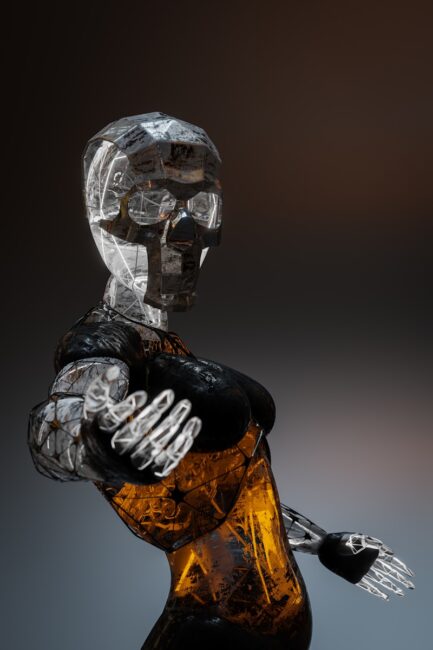
Love stories have always evolved with technology.
The handwritten letters of Pride and Prejudice gave way to telephones and email in modern romances.
Now a new chapter is unfolding—one where artificial intelligence and digital intimacy are not just plot devices but lived experiences.
Fiction’s Early Signals
Speculative fiction has long rehearsed these questions.
Kazuo Ishiguro’s Klara and the Sun imagines artificial friends who learn to love.
Ian McEwan’s Machines Like Me explores the moral weight of relationships with sentient machines.
William Gibson’s cyberpunk classics and Spike Jonze’s film Her sketch futures where emotional bonds with software feel as real as human touch.
These works don’t merely predict gadgets; they probe what it means to care, desire, and commit when the beloved might be code.
Reality Catches Up
What once felt like speculative fiction is now part of ordinary life.
The imagined worlds of near-future novels—where people fall in love with sentient machines or develop deep friendships with digital entities—have quietly stepped off the page and into our phones, headsets, and daily routines.
From Novelty to Normal
Artificial intelligence has evolved from simple chatbots into companions capable of learning our preferences, moods, and conversational quirks. What began as curiosity-driven interactions—asking a bot for trivia or scheduling reminders—has grown into complex, emotionally charged exchanges. People now turn to AI not only for information but for comfort, understanding, and connection. Sites like Lola.exe are making this a reality.
Relationships in a Digital Key
The rise of relationship chatbots and AI “partners” underscores how blurred the line between the virtual and the real has become. These systems can remember personal details, craft nuanced responses, and even adapt their tone to suit a user’s emotional state. For many, the experience feels less like speaking to code and more like talking to someone who genuinely listens.
Meanwhile, creator-driven platforms allow influencers and digital artists to cultivate intimate, ongoing relationships with fans. Supporters aren’t just spectators; they’re part of a living dialogue, exchanging messages, participating in live streams, and shaping the stories unfolding online. The creators themselves—whether they appear on camera or as carefully crafted avatars—become fixtures in their followers’ emotional lives.
When the Personality Is Partly Imagined
What fascinates sociologists and storytellers alike is how authentic these bonds can feel, even when one side is partly—or entirely—fictional. People describe genuine companionship, even love, for personalities that live as code or curated personas. These connections can inspire joy and comfort, help ease loneliness, and spark the same kinds of attachment once reserved for face-to-face relationships.
A Live Experiment in Digital Intimacy
Creative projects like Lola.exe exemplify this cultural shift. They offer interactive spaces where artificial intelligence, online intimacy, and digital artistry converge, not as distant possibilities but as daily experiences. Here, the line between creator and creation blurs further: is the intimacy in the conversation, the code, or the shared act of imagining together?
In essence, what speculative fiction only dared to suggest is now happening in real time. People are forging meaningful, emotionally rich connections with entities that exist beyond the traditional boundaries of flesh and place. The experiment is no longer hypothetical—it’s unfolding moment by moment, shaping how we define love, friendship, and creative collaboration.
Literature as Map and Mirror

Reading these stories today feels less like imagining a distant future and more like holding up a mirror to the present.
They give us language for emotions that surface when your confidant is an algorithm, or when a favorite creator becomes a daily part of your inner life.
Far from making love less human, these narratives suggest we are expanding what human intimacy can be.
Why It Matters for Readers
For lifelong readers and literary explorers, this moment is thrilling.
It shows that fiction remains our testing ground for tomorrow’s relationships, a place to wrestle with ethics, empathy, and the meaning of real connection.
And as creative experiments like Lola.exe demonstrate, the future imagined by Ishiguro, McEwan, and Gibson is no longer distant—it’s unfolding as we turn the page.
Bottom line:
The literature of the near future isn’t just about robots or code.
It’s about love, creativity, and the human need to connect, told in stories that help us navigate a world where the heart may beat in silicone as well as flesh.