
In a dystopian world where “Big Brother” seems less like fiction and more like a reality TV show gone too far, George Orwell’s “1984” serves as a cautionary tale wrapped in a dystopian bow. This chilling narrative not only critiques totalitarianism but also delves into the resilience of the human spirit and individualism and the chilling power of language. Buckle up as we explore Orwell’s prescient lessons on control, rebellion, and the delicate dance of relationships-because understanding the past might just be our best defense against the future!
Context of the Novel

Written in 1949, ‘1984’ serves as George Orwell’s witty yet harrowing commentary on his experiences during World War II and the rise of totalitarianism in Europe-talk about being ahead of the curve in understanding political discourse, oppression, and ethical implications!
Orwell’s time in Spain during the Spanish Civil War, coupled with the stark realities of Stalinism, profoundly shaped his narrative, highlighting the historical context of his socio-political critique. The oppressive regimes he observed didn’t just give him food for thought on authoritarianism and indoctrination; they provided a veritable banquet of concerns about surveillance, propaganda, and the artful manipulation of truth-integral themes in ‘1984’ that are as relevant today as they were then.
Take the Ministry of Truth, for example, a symbol of government control and censorship. It mirrors the Soviet propaganda machine, demonstrating how language can be twisted to warp perception faster than a magician can pull a rabbit from a hat.
By weaving in real-world events, Orwell crafted a cautionary tale that resonates with an ever-present climate of fear and oppression, issuing a stark warning to readers about the perils of unchecked governmental power. It’s a narrative that reminds us: when it comes to authority, a little skepticism goes a long way.
Overview of Key Themes
‘1984’ masterfully intertwines the themes of surveillance, propaganda, and the relentless quest for individuality within a stifling regime. At the heart of this narrative lies the Ministry of Truth, an allegory of propaganda machine and language manipulation, a shining example of how history and information can be expertly manipulated.
The Party, through this institution, aims to maintain conformity and control, doesn’t just tweak a few records; it rewrites the past to ensure its version of reality stands unchallenged, showcasing the rather ironic concept of ‘doublethink’-the ability to hold two contradictory beliefs simultaneously, as if mental gymnastics were an Olympic event.
Take, for instance, Winston Smith’s poignant epiphany that “Who controls the past controls the future.” This phrase encapsulates the essence of authoritarian control with a touch of chilling accuracy. Such relentless revisionism not only stifles dissent but also gnaws away at personal autonomy, plunging citizens into a murky sea of perpetual ignorance.
One might say that in this world, knowledge isn’t just power; it’s tied to human rights and freedom of expression, it’s the ultimate luxury, and unfortunately, it’s one that most are denied.
The Nature of Totalitarianism
Totalitarianism in ‘1984’ embodies a remarkable degree of control over civil liberties, over information and personal freedoms, crafting a society that is, quite frankly, a veritable wasteland for individual thought.
One might say it’s a dystopian paradise for those who prefer their minds on lockdown, avoiding critical thinking and empathy, where independent thinking is not just discouraged but practically outlawed.
Control of Information
The Ministry of Truth serves as a prime example of how totalitarian regimes artfully twist historical facts to maintain their grip on collective memory and history, on power. This manipulation, akin to a magician pulling a rabbit out of a hat, is accomplished through a combination of censorship and historical revisionism, fundamentally reshaping collective memory.
Take, for instance, George Orwell’s “1984,” where the Ministry diligently rewrites newspapers and records, ensuring that the Party is portrayed as infallible-like a superhero in a never-ending comic book, embodying the themes of deception and truth manipulation. A particularly interesting tactic is the Newspeak language, crafted to eliminate words associated with rebellion and individual rights, thereby narrowing the spectra of thought to a mere flicker.
In the real world, similar regimes may choose to erase or glorify specific historical events, impacting societal norms and critical thinking, subtly influencing citizens’ perceptions and ensuring a smooth compliance with the ruling ideology. This strategy effectively consolidates power by controlling not only the present but also the narrative of the past, transforming history into a tool for dominance, all while leaving the populace none the wiser.
Surveillance and Privacy
The omnipresence of ‘Big Brother’ in ‘1984’ serves as a rather chilling reminder of the invasive surveillance tactics employed to keep the populace in check.
In Orwell’s dystopia, telescreens are not merely gadgets; they function as dual agents of oppression-broadcasting propaganda while simultaneously keeping a watchful eye on citizens. This relentless psychological manipulation creates a pervasive atmosphere of fear, effectively coercing individuals into self-censorship.
Fast forward to our modern world, and we can readily observe a similar dynamic at play within social media platforms, reflecting the psychological manipulation and surveillance tactics in our society. Here, user data is meticulously tracked in a relentless quest to predict behavior and sway choices-what a delightful thought in the realm of surveillance and technology!
The infamous case of Cambridge Analytica starkly illustrates the workings of surveillance capitalism, often operating in the shadows of explicit consent, deftly shaping personal opinions and influencing public discourse.
Both scenarios draw attention to the precarious balance between security and personal freedom, igniting a crucial dialogue on privacy and human relationships, in our digital age. After all, in a world where ‘Big Brother’ might just be your smartphone, one must ponder: are we the masters of our devices, or merely their subjects?
The Human Spirit and Resistance
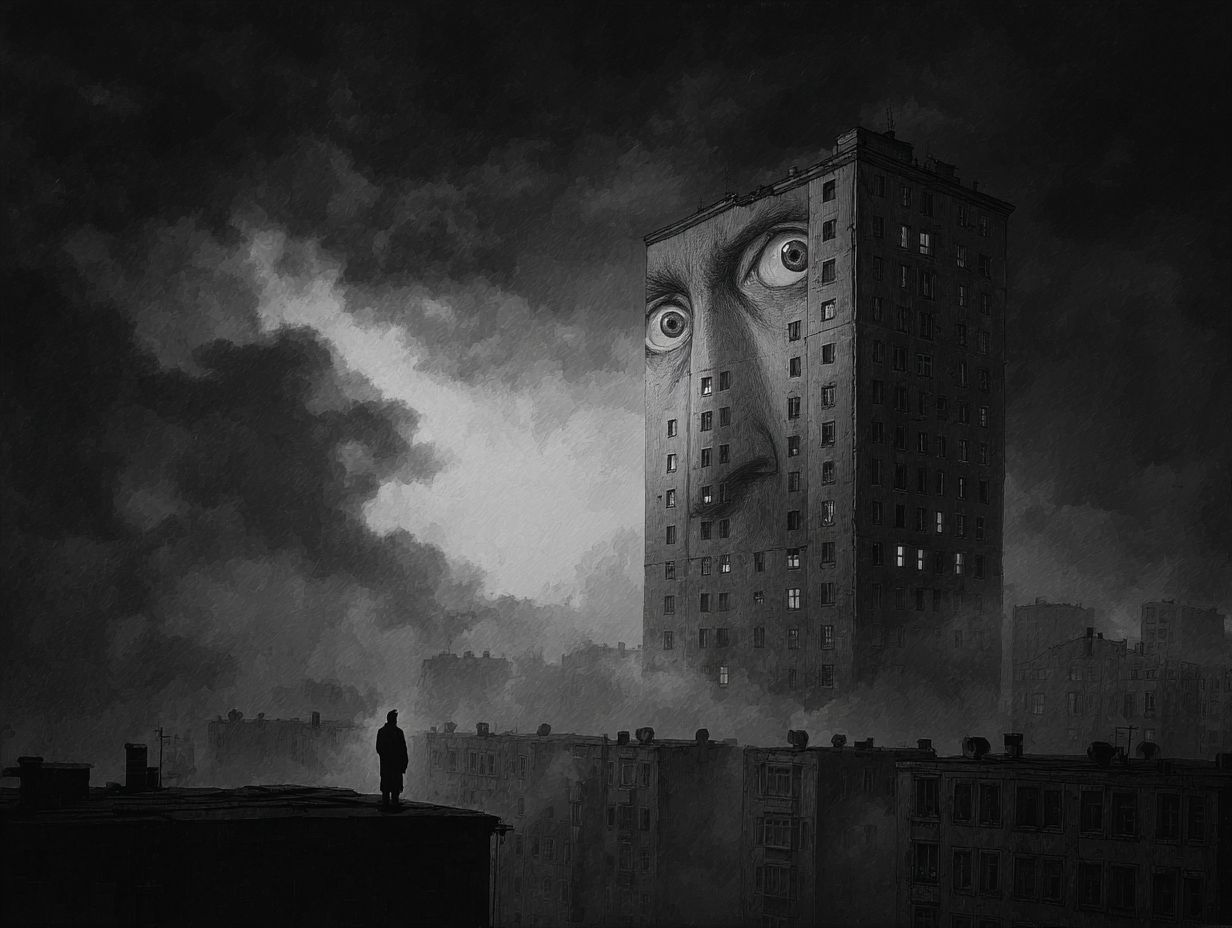
Despite the weighty constraints of an oppressive regime, ‘1984’ masterfully illustrates the unyielding resilience of the human spirit through acts of rebellion and resistance, however modest they may be.
It’s almost as if the characters are saying, “Big Brother may be watching, but we’ll find a way to give him the proverbial finger in a dance of fate and determinism.”
Winston Smith’s Rebellion
Winston Smith’s journey serves as a vivid illustration of the battle against indoctrination and psychological impact, as he valiantly seeks truth in a world inundated with deception. His rebellion begins with the seemingly innocuous act of keeping a diary-an audacious maneuver that challenges societal norms, that enables him to articulate his thoughts and fortify his resistance to oppressive ideologies.
This simple act of writing transforms into a powerful tool for self-discovery and give the power toment, proving that even the most unassuming actions can wield significant influence.
In a delightful twist of fate, Winston embarks on a forbidden romance with Julia, exploring human experience and individualism, which epitomizes personal rebellion and the quest for authentic connections in an otherwise sterile existence. Their intimacy not only nurtures a sense of individuality but also starkly contrasts the Party’s relentless dehumanization.
These bold actions underscore Winston’s profound longing for freedom and truth in a repressive regime, highlighting human rights and the power of language, illuminating the crucial role of personal expression in the relentless pursuit of identity.
In a world that seeks to stifle the spirit, he stands as a testament to the enduring power of individuality and the quest for truth, exemplifying human resilience and societal critique.
Hope and Despair
The intricate dance between hope and despair in ‘1984’ exquisitely illustrates the precarious balance between resistance and submission, reflecting the existentialism and nihilism of human consciousness. Throughout the narrative, Winston’s fleeting glimpses of hope-epitomized by his clandestine rendezvous with Julia and his rebellious musings-stand in stark relief against the all-encompassing oppression of the Party.
Take, for example, his yearning for authentic human connection, which serves as a subtle act of defiance against totalitarianism and alienation. However, as he contends with the Party’s relentless surveillance and psychological manipulation, that hope begins to slip through his fingers like grains of sand, perfectly mirroring the struggles faced by individuals in oppressive regimes.
This dichotomy not only delivers a striking commentary on resilience in the face of crushing despair and emotional impact, but also underscores the fragility of the human spirit when ensnared by authoritarian rule.
Language as a Tool of Control
In George Orwell’s ‘1984’, language is not merely a tool for communication; it is a critical tool for social justice and cultural influence, it is expertly weaponized as a means of controlling thought itself, most notably through the ingenious creation of Newspeak.
Who knew that a vocabulary reduction could serve as a totalitarian’s best friend?
Newspeak and Thought Control
Newspeak, the official language of Oceania, is ingeniously crafted to obliterate any potential for rebellious thoughts and control personal identity, At the heart of this linguistic endeavor lies a rather amusing principle: the systematic reduction of vocabulary, embodying the aspects of memory manipulation and alienation,
By narrowing the spectrum of words, Newspeak effectively aims to box in complex thought, much like a skilled magician performing a disappearing act on ideas.
Take, for instance, the term ‘freedom.’ In the whimsical world of Newspeak, where ethics and morality are in flux, it metamorphoses into ‘unfreedom,’ effectively vanishing the very concept from political discourse. Phrases that might stir the pot of dissent, such as ‘revolution’ or ‘justice,’ are conveniently replaced with the more palatable ‘the Party’s interests.’
By erasing these subtle distinctions, the language seeks to dictate the thoughts of individuals, impacting their ethical implications, ensuring that any notion of rebellion remains not just improbable but utterly unthinkable. It’s a clever trick, indeed, that makes one ponder whether the true magic lies in the words left unsaid.
The Power of Words

Orwell masterfully illustrates that mastery over language equates to mastery over reality itself, showcasing timeless lessons and literary significance. This notion is brought to life in ‘1984’ through the ingenious creation of Newspeak, a language designed to stifle independent thought.
Take, for example, the word ‘freedom,’ which is gradually rendered utterly meaningless, stripped of any conceptual relevance-much like a balloon deflating at a rather unfortunate birthday party.
By replacing ordinary words with politically charged alternatives, the Party guarantees that citizens view reality through a narrow, tightly controlled lens. Linguistic analysis serves as a valuable tool for dissecting these transformations, revealing just how the party plays with words like a puppeteer with strings.
Readers are invited to delve into key passages, noting how specific word choices shape characters’ beliefs and actions. This scrutiny highlights the profound-and often unsettling-relationship between language and ideology, reminding us that words wield much more power than we might assume.
The Role of Relationships in George Orwell’s Narrative
The relationships depicted in ‘1984’ elegantly illustrate the clash between personal desires and allegiance to the state, offering a nuanced perspective on human connections and human condition in the face of oppression.
It seems that in a world where Big Brother looms large, even romance becomes a tightrope walk between passion and paranoia.
Love vs. Loyalty
The tumultuous relationship between Winston and Julia serves as a vivid illustration of the friction between personal love and the unwavering loyalty demanded by the Party. Their romance stands as a bold act of defiance against a regime that frowns upon emotional connections, rather like trying to plant a rose in a concrete jungle.
In their secret meetings, Winston Smith and Julia discover a refuge, exchanging forbidden ideas and experiences that fly in the face of the Party’s ideology. Each stolen moment is akin to a breath of fresh air in a stifling environment, illuminating love as both a haven and a perilous venture.
Their vulnerability is palpable as they wade through the murky waters of trust and fear-emotionally intertwined yet acutely aware that a single betrayal could lead to ruin. This dynamic ultimately reflects the desperate struggle between individual longing and the oppressive machinery of a totalitarian state, showcasing just how complex and fraught love can be when the stakes are this high.
Isolation in a Totalitarian State: A Social Commentary
In George Orwell’s *1984*, isolation transforms into a formidable weapon, effectively stripping individuals of their humanity and fortifying the grip of state control. Through relentless surveillance and the eradication of personal relationships, the authorities cultivate a suffocating atmosphere of loneliness that permeates every corner of existence.
Take, for example, the Party’s ingenious manipulation of language through Newspeak. This clever linguistic trickery limits the potential for dissenting thoughts, rendering rebellion a moot point. Meanwhile, the infamous ‘Two Minutes Hate’ serves as a delightful exercise in collective animosity, fostering distrust among individuals as they engage in their daily dose of manufactured outrage, highlighting the social hierarchy engineered by the regime.
The ever-watchful eye of the telescreen ensures that privacy is but a distant memory, keeping citizens under constant scrutiny. Consequently, the regime skillfully nurtures a culture where solitude is not merely a source of despair but a strategic barrier against the formation of rebellious alliances. In this grim landscape, the Party maintains its complete dominance over the populace, proving that loneliness can indeed be a most effective tool of oppression.
Relevance of “1984” in Modern Society
The themes of ‘1984’ resonate remarkably well in today’s conversations surrounding privacy, state surveillance, and the influence of media. One need only look at the rise of facial recognition technology and the omnipresent tracking by social media to witness Orwell’s notion of perpetual surveillance in action, underscoring the historical relevance of his insights.
Companies such as Clearview AI have taken the avant-garde step of utilizing vast databases of public images to create real-time identification systems, prompting quite the uproar over personal privacy-or rather, the lack thereof.
Meanwhile, platforms like Facebook and Twitter have taken it upon themselves to orchestrate algorithmic feeds, effectively steering the narrative on current events with the finesse of a seasoned puppeteer. This scrutiny mirrors the propaganda tactics Orwell warned us about, making his insights chillingly pertinent as we navigate a world where information wields both power and peril, with social commentary reflecting our modern dilemmas.
It’s as if he had a crystal ball that foresaw our digital dilemmas!
Frequently Asked Questions

What lessons in humanity’s flaws can we learn from George Orwell’s “1984”?
Orwell’s classic novel “1984” offers many important lessons about the human condition, including the dangers of totalitarianism, the power of language, and the importance of individual thought and freedom. It is a profound literary analysis of human flaws and resilience.
How does “1984” warn against the dangers of totalitarianism?
In the novel, the government controls every aspect of its citizens’ lives, from their thoughts to their actions. This serves as a warning against the dangers of giving too much power to a single entity, as it can lead to oppression and loss of individual rights.
What lessons does “1984” teach us about the power of language?
The novel showcases how language can be used as a tool for manipulation and control. The government in “1984” creates its own language, Newspeak, to limit the range of thought and eliminate ideas that could challenge its authority.
How does “1984” emphasize the importance of individual thought and freedom?
The main character, Winston, rebels against the oppressive society by maintaining his own thoughts and beliefs, despite the constant surveillance and brainwashing. This shows the value of individuality and the dangers of suppressing it.
What can we learn about humanity through the character of Winston in “1984”?
Winston’s struggle against the oppressive government highlights the resilience and determination of the human spirit. It also reminds us of the importance of standing up for our beliefs and fighting against injustice.
What impact does the novel “1984” have on our understanding of humanity?
Through its depiction of a dystopian society, “1984” forces us to reflect on the dark side of human nature and the potential for corruption and abuse of power. It serves as a cautionary tale of moral lessons and reminds us to constantly question and challenge authority.